PhilHealth Authorization Letter: How to Write One + Free Sample (2026)
PhilHealth Authorization Letter: How to Write One + Free Sample (2026)
Can’t go to PhilHealth personally? You don’t have to — as long as you have the right letter.
This guide gives you everything you need: what to write, what to bring, and a ready-to-copy sample.
Going to a PhilHealth office personally is not always possible. You might be working abroad, recovering from an illness, or simply tied up with obligations. That’s exactly why PhilHealth accepts an authorization letter — a simple written document that lets someone else handle your transactions on your behalf. Whether you need to claim your PhilHealth ID, update your Member Data Record (MDR), add dependents, or pay contributions, an authorized representative can do all of that for you as long as the letter is properly prepared.
This guide covers everything you need to know: when you need one, who you can authorize, what to include in the letter, common mistakes that get letters rejected, and ready-to-copy samples in both English and Tagalog. There is important fact that you need this letter when you can’t go physically and also Online PhilHealth Portal don’t has any option to resolve problem.
What Is a PhilHealth Authorization Letter?
A PhilHealth authorization letter is a signed written consent from a PhilHealth member allowing another person to transact on their behalf at any PhilHealth office or Local Health Insurance Office (LHIO). It gives your representative the legal standing to access your account, submit documents, or claim certain items — all without your physical presence.
PhilHealth does not have a standard printed form for this purpose. Members write the letter themselves, which means the format is flexible, but the content must meet PhilHealth’s basic requirements to be accepted. A poorly written or incomplete letter will be turned away at the counter, causing unnecessary delays and trips.
When Do You Need a PhilHealth Authorization Letter?
You need an authorization letter whenever you cannot personally appear at a PhilHealth office to handle a transaction. Common situations include:
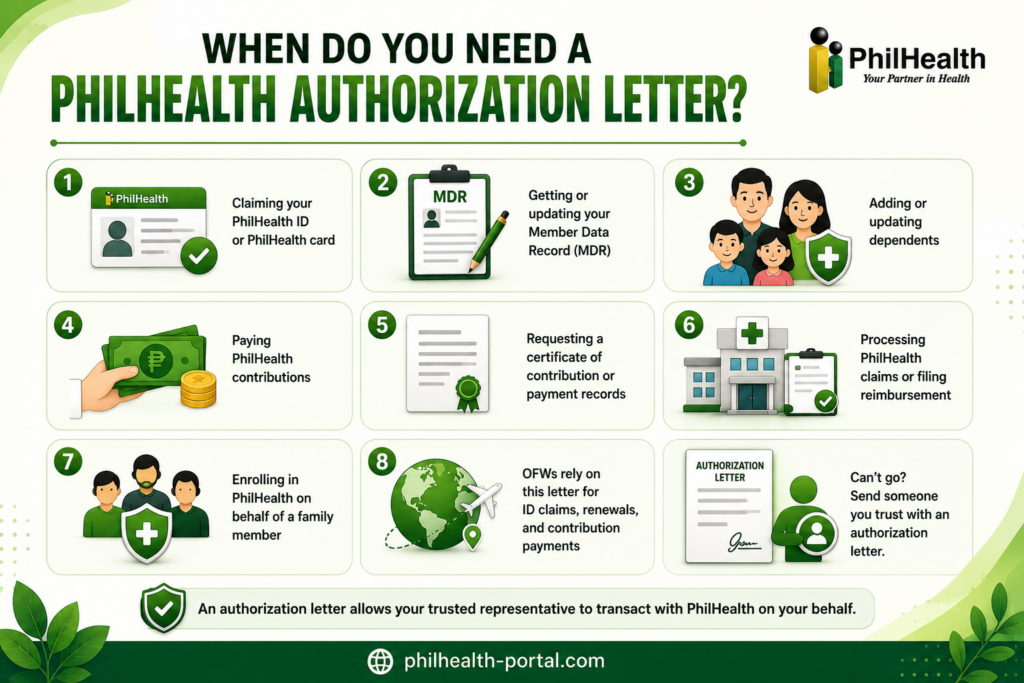
OFWs (Overseas Filipino Workers) in particular rely on this letter heavily since their relatives back home often handle renewals, ID claims, and contribution payments on their behalf.
Who Can You Authorize?
You can authorize any person you trust to represent you at PhilHealth. There is no strict rule requiring the representative to be a relative, but practically speaking, most Filipinos authorize a close family member — a spouse, parent, sibling, or adult child — since they are more likely to be trusted and can vouch for the member’s identity if questioned.
If you are authorizing a non-relative, make sure they carry strong identification and are fully briefed on your PhilHealth details. Some LHIO staff may ask clarifying questions, and your representative should be able to answer them confidently.
Documents Your Representative Must Bring
Your representative needs to arrive prepared. An authorization letter alone is rarely enough — PhilHealth staff will ask for supporting documents from both the member and the representative.
| Document | Who It Belongs To |
|---|---|
| Signed authorization letter (original) | Member (you) |
| Valid government-issued ID of the member | Member (you) — photocopy |
| Valid government-issued ID of the representative | Representative |
| PhilHealth ID or PhilHealth Number (PIN) | Member (you) |
| Relevant forms or documents for the transaction | Depends on purpose |
For MDR-related transactions, some LHIO branches also ask for a photocopy of the member’s ID front and back, duly signed. It is always safer to bring both originals and photocopies.
How to Write a PhilHealth Authorization Letter
Writing the letter is straightforward once you know what to include. Use clean white paper, type or write legibly, and make sure you sign personally — do not let someone else sign on your behalf.
Required Elements of the Letter
Every PhilHealth authorization letter must contain:
Be as specific as possible about what the representative is allowed to do. Avoid vague phrases like “all transactions.” If you are authorizing someone to pick up your MDR, say exactly that.
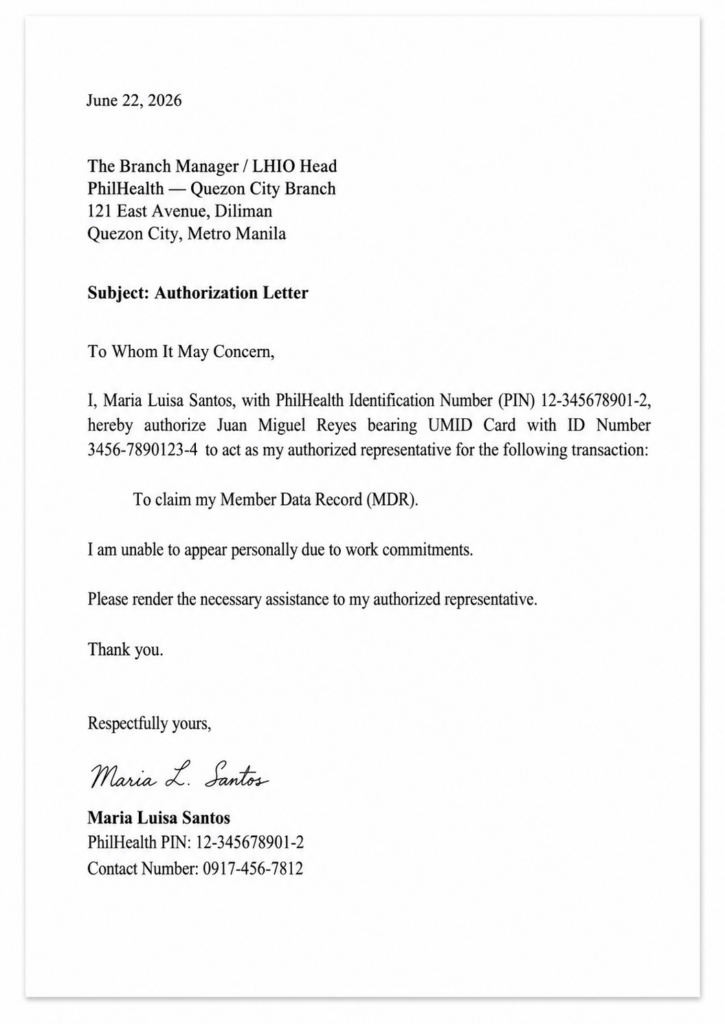
Sample Authorization Letter for PhilHealth (English Version)
[Date]
The Branch Manager / LHIO Head
PhilHealth — [Branch Name]
[Branch Address]
Subject: Authorization Letter
To Whom It May Concern,
I, [Your Full Name], with PhilHealth Identification Number (PIN) [Your PIN], hereby authorize [Representative’s Full Name] bearing [ID Type] with ID Number [Representative’s ID Number] to act as my authorized representative for the following transaction:
- [State the specific transaction, e.g., “to claim my Member Data Record (MDR)” / “to claim my PhilHealth ID” / “to update my dependents”]
I am unable to appear personally due to [brief reason, e.g., “work commitments” / “I am currently based abroad”].
Please render the necessary assistance to my authorized representative.
Thank you.
Respectfully yours,
[Your Signature over Printed Name]
PhilHealth PIN: [Your PIN]
Contact Number: [Your Phone Number]
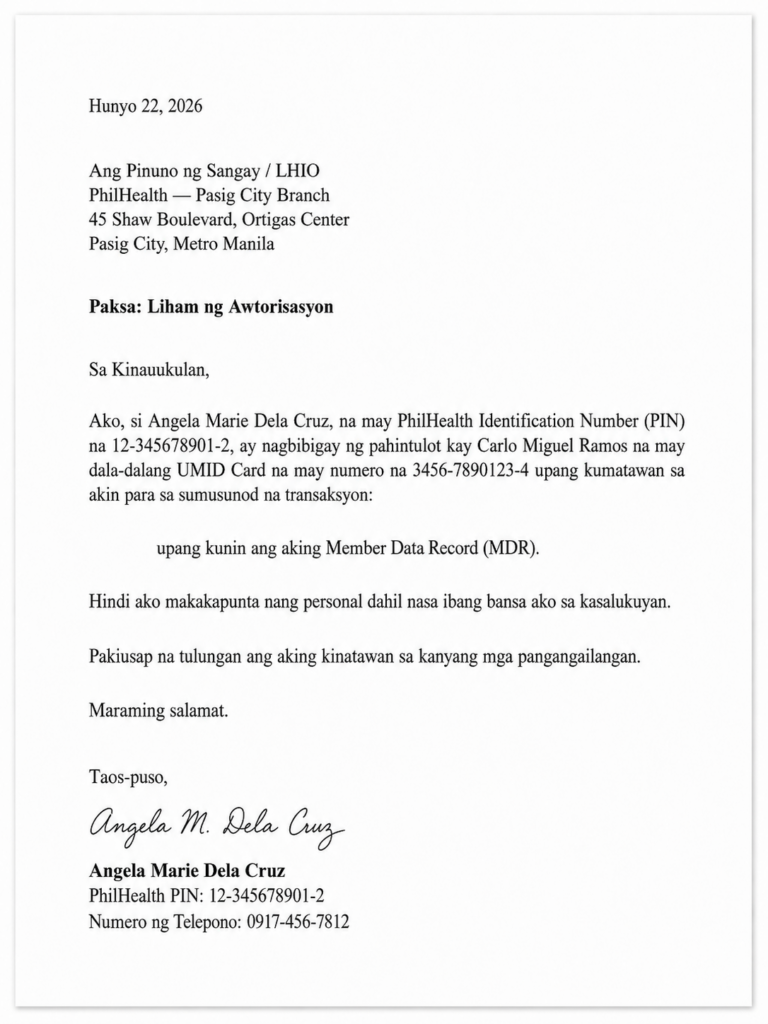
Sample Authorization Letter for PhilHealth (Tagalog Version)
[Petsa]
Ang Pinuno ng Sangay / LHIO
PhilHealth — [Pangalan ng Sangay]
[Address ng Sangay]
Paksa: Liham ng Awtorisasyon
Sa Kinauukulan,
Ako, si [Iyong Buong Pangalan], na may PhilHealth Identification Number (PIN) na [Iyong PIN], ay nagbibigay ng pahintulot kay [Buong Pangalan ng Kinatawan] na may dala-dalang [Uri ng ID] na may numero na [ID Number ng Kinatawan] upang kumatawan sa akin para sa sumusunod na transaksyon:
- [Ilagay ang partikular na transaksyon, hal., “upang kunin ang aking Member Data Record (MDR)” / “upang kunin ang aking PhilHealth ID”]
Hindi ako makakapunta nang personal dahil [maikling dahilan, hal., “nasa ibang bansa ako sa kasalukuyan”].
Pakiusap na tulungan ang aking kinatawan sa kanyang mga pangangailangan.
Maraming salamat.
Taos-puso,
[Iyong Pirma sa Itaas ng Naka-print na Pangalan]
PhilHealth PIN: [Iyong PIN]
Numero ng Telepono: [Iyong Numero]
Common Mistakes That Get Authorization Letters Rejected
Many authorization letters get turned away at PhilHealth counters for avoidable reasons. Here are the most common problems members run into:
Vague Transaction Description
Writing “for all PhilHealth purposes” is too broad. Staff will ask you to be specific, and if the letter does not state the exact transaction, they may refuse it. Name the exact purpose clearly.
Missing PhilHealth PIN
Your PhilHealth Identification Number is essential. Without it, the representative cannot be matched to your account and the transaction cannot proceed.
No Valid ID From The Member
Even if you are not physically present, PhilHealth may require a photocopy of your valid ID signed by you. Skipping this is one of the top reasons letters get rejected.
Representative Has No Valid ID
The authorized person must show their own government-issued ID. A photocopy is typically not accepted — the original must be presented.
Using Someone Else’s Signature
The authorization letter must bear your own actual signature, not a printed name or someone signing on your behalf. If PhilHealth staff suspect the signature is not genuine, they can decline the request.
Outdated Letter
Some branches are stricter about date validity. Write the letter close to the date of the actual transaction and avoid using a letter that is weeks or months old.
Tips for a Smooth Transaction
Calling ahead saves a lot of time. Contact your nearest PhilHealth LHIO before sending your representative to confirm exactly which documents they require for your specific transaction. Requirements can vary slightly between branches and transaction types.
Give your representative a photocopy of your PhilHealth ID or your complete PIN details. They should also know your date of birth, registered address, and PhilHealth Employer history in case they are asked to verify identity. The more information your representative has, the faster the transaction goes.
Keep a copy of the authorization letter for yourself. If the transaction is disputed later or needs to be repeated, having a copy on hand avoids having to rewrite the letter from scratch.
Frequently Asked Questions
Does PhilHealth have an official authorization letter form?
No. PhilHealth does not issue a standard printed form for authorization. Members write their own letter on plain paper or letterhead. As long as the content is complete and the signature is genuine, the format is acceptable.
Can I authorize anyone, or does it have to be a family member?
You can authorize any person you trust, not necessarily a relative. However, most LHIO branches look more favorably on close family members. If you are authorizing a non-relative, make sure they carry strong identification and can verify basic personal details about you.
What if my PhilHealth ID is already printed — can my representative claim it?
Yes, that is one of the most common uses of an authorization letter. Your representative must present the signed letter plus your valid ID photocopy and their own valid ID. Some branches may also ask for a photocopy of your PhilHealth application form.
Can an authorization letter be used for PhilHealth MDR transactions?
Yes. An authorization letter for PhilHealth MDR is widely accepted. Your representative can request, pick up, or update your MDR using the letter as long as all supporting documents are complete.
How long is a PhilHealth authorization letter valid?
PhilHealth does not publish a fixed validity period, but most branches treat the letter as valid only for the specific transaction and date indicated. Write a fresh letter for each visit to avoid being turned away.
Can an OFW use an authorization letter for PhilHealth contributions?
Yes. OFWs based abroad regularly use authorization letters so that a family member in the Philippines can pay their contributions at a PhilHealth office or authorized payment center. The letter should clearly state that the representative is authorized to pay contributions on the member’s behalf.
What happens if the PhilHealth branch rejects my authorization letter?
Ask the staff what specific document or detail is missing and address it immediately. Most rejections are due to incomplete information, missing IDs, or a vague transaction description — all of which can be corrected with a revised letter and another visit.