PhilHealth Benefits 2026: Complete Coverage by Type, Condition & Membership
PhilHealth covers hospitalization, maternity, outpatient care, Z-benefits for catastrophic illness, and more. Here’s exactly what you’re covered for in 2026 — from normal delivery to cancer treatment to dialysis.
PhilHealth covers 85% of Filipinos. Understanding what you’re actually covered for matters more than knowing you have a membership. This article breaks down every benefit type, every condition covered, and every membership category so you know what to expect before you need it.
What Is PhilHealth & What Does It Cover?
PhilHealth is the National Health Insurance Program of the Philippines. It’s mandatory coverage for all citizens and provides benefits for employed workers, self-employed members, and those in the informal economy. Your PhilHealth membership pays for hospitalization, outpatient consultations, maternity care, emergency services, and increasingly, preventive care.
The coverage works through case rates, meaning PhilHealth pays a fixed amount per diagnosis, not per day or per procedure. A normal delivery has one case rate; a cesarean section has another. A hypertension hospitalization has its rate; a stroke has a different one. You pay the difference if the actual bill exceeds the case rate, or you get a refund if it’s less.
What PhilHealth covers has expanded significantly since 2024. The introduction of YAKAP (Yaman ng Kalusugan Program) in 2025 added free outpatient consultations, laboratory tests, and an essential medicines list to the benefit package. Senior citizens aged 60 and above receive lifetime, premium-free coverage. PWD members get extended benefits. The program now covers catastrophic illness through Z-benefits, dialysis for chronic kidney disease, and mental health services.
PhilHealth Benefits by Type
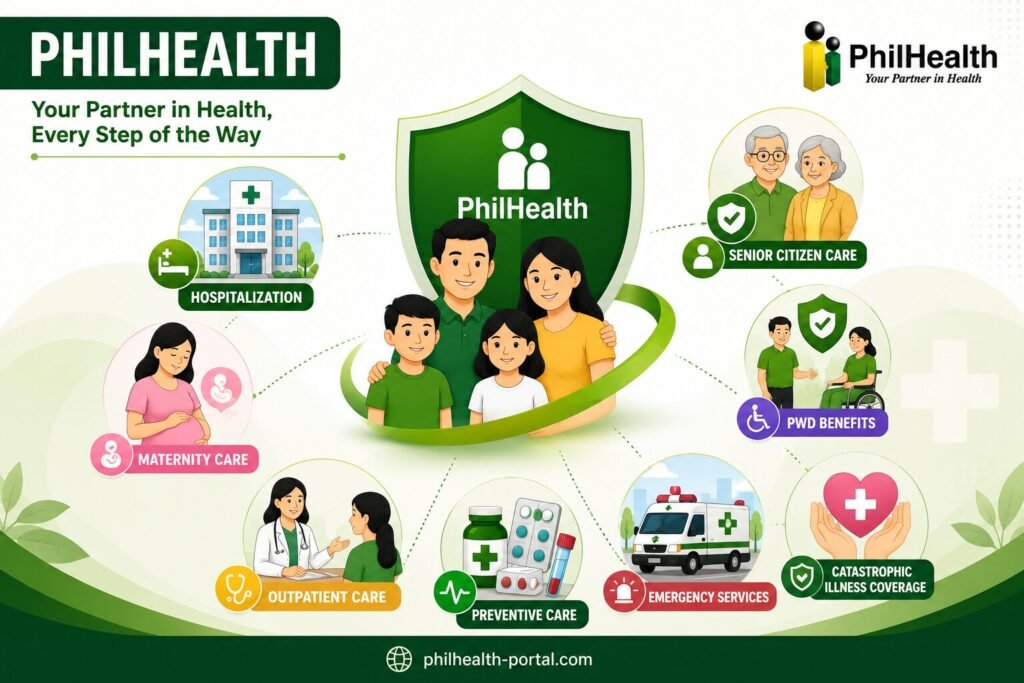
Hospitalization Benefits
Hospitalization is PhilHealth’s core benefit. When you’re admitted to an accredited facility, PhilHealth pays a fixed case rate based on your diagnosis. The case rate covers the hospital stay, meals, nursing care, and basic supplies. It does not cover the doctor’s professional fee, medications, or certain specialized procedures — you pay these separately or they’re covered by your co-insurance if you have private insurance.
Case rates vary dramatically by condition. A simple pneumonia hospitalization costs less than a cancer surgery. The 45-day benefit limit means PhilHealth covers up to 45 days of continuous hospitalization per year; readmission within 90 days counts as the same hospitalization period. This is called the Single Period of Confinement (SPC) rule.
Most hospitalization benefits are delivered at government hospitals and rural health units, where you typically pay nothing beyond the small co-payment. At private hospitals, you pay the difference between the PhilHealth case rate and the actual bill. At non-accredited hospitals, PhilHealth reimburses you after you file a claim.

Maternity Benefits
PhilHealth covers normal delivery and cesarean section, including comprehensive pre-natal care through accredited clinics. The normal delivery benefit covers hospitalization, delivery, and post-natal care. As of 2026, maternity coverage now extends beyond hospitals to birthing homes, primary care facilities, and infirmaries
Maternity services now include full antenatal (pre-natal) care such as regular check-ups, screenings, and management of pregnancy-related conditions, as well as birthing services for normal delivery and emergency referral systems for complications. Diagnostic services including routine antenatal work-up (laboratory tests and imaging) are covered. Post-natal care continues after delivery at accredited facilities.
Complications during pregnancy — gestational diabetes, preeclampsia, hemorrhage — are covered under hospitalization benefits, not the basic maternity benefit. A stillbirth is covered; a miscarriage is not. PhilHealth enforces a strict ‘No Co-Payment’ policy, meaning members should not be charged additional fees beyond what PhilHealth covers for maternity services.
Outpatient Benefits (YAKAP)
YAKAP replaced the older Konsulta program. It provides free consultations at primary care facilities — rural health units, public health centers, and partnered clinics — for all members. No co-payment. No referral required. You can see a doctor without being hospitalized.
YAKAP includes 13 laboratory tests per year at no cost: blood glucose, urinalysis, lipid profile, chest X-ray, and nine others. It covers essential medicines from a list of 75 drugs, with 21 guaranteed in stock at participating facilities. Patients pay 25% of the medicine price; PhilHealth covers the rest. Mental health consultations at RHU mental health programs are covered. Dental preventive care — oral prophylaxis, scaling, extraction of primary teeth — is covered at public health centers.
YAKAP does not cover specialist visits, procedures beyond the basic scope, or medicines not on the essential list. For specialist care or procedures needing hospitalization, you move to the hospitalization benefit.
GAMOT and New Preventive Services
PhilHealth GAMOT (Guaranteed and Accessible Medications for Outpatient Treatment) provides access to affordable essential medicines through the primary care program, launched in 2026. Members can purchase medicines at accredited pharmacies at a reduced cost, with PhilHealth covering a significant portion of the price.
Preventive oral health services are now included in primary care at no cost. Coverage includes oral health screening, professional cleaning (prophylaxis), fluoride varnish application, pit and fissure sealants, and Class V restorations (limited to two teeth per year) at accredited clinics and health centers. Emergency tooth extractions are also covered when necessary and medically indicated.
Z-Benefits for Catastrophic Illness
Pre-authorization is mandatory before treatment begins. Patients must submit a Pre-authorization Checklist and Request Form to PhilHealth for approval. The form is available at www.philhealth.gov.ph/downloads/ or at your nearest Local Health Insurance Office (LHIO). Without pre-authorization, claims may be denied.
Cancer coverage includes chemotherapy, radiation, and targeted therapy. Dialysis covers hemodialysis and peritoneal dialysis (PD) sessions. Cardiac benefits cover bypass surgery, angioplasty (coronary intervention), and valve replacement. Organ transplant covers the surgery and immunosuppressive drugs.
For kidney transplants specifically, living donor transplants are covered up to over P1 million, while deceased donor transplants are covered up to P2.14 million as of 2026. Kidney transplant patients must be registered in the KT Data Registry System. Manual submissions of the KT Data Registry Form are accepted until April 30, 2026; after May 1, 2026, all registrations must be through the online system.
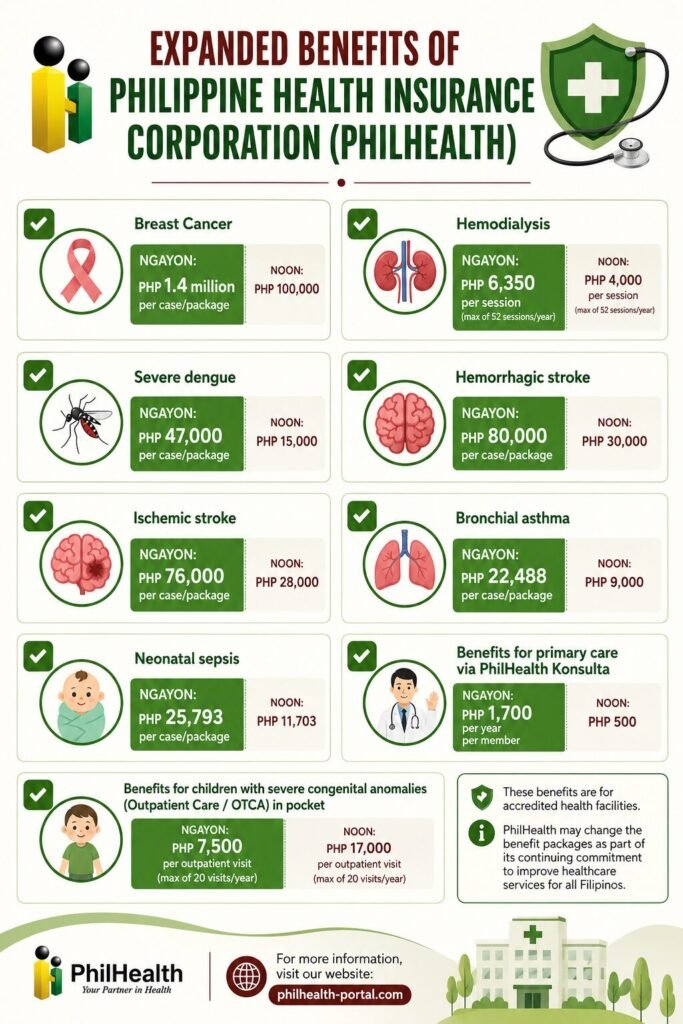
For dialysis, peritoneal dialysis (PD) Z-Benefits for adults have been set at P389,640 and P510,140 depending on the PD solutions required, with increases up to 89% from previous coverage amounts. PhilHealth also covers PD-related complications such as exit site infections and peritonitis prevention. Dialysis coverage extends to 52 sessions per year for chronic kidney disease.
For cardiac procedures, coverage for percutaneous coronary intervention (PCI) or coronary angioplasty has been significantly expanded to P524,000 as of 2026, an increase of over 1,600% from the previous amount, to reflect modern treatment costs and patient needs.
The catch: Z-benefits require prior registration in YAKAP (completion of at least one primary care encounter) and documentation of the condition before you can claim the benefit. Upon discharge from treatment, patients must submit a Discharge Checklist with all mandatory documents to file claims.
PWD (Person with Disability) Benefits
PhilHealth PWD members get extended dependent benefits — children with disabilities aged 21 and above remain covered as dependents without age limit. PWD members also get priority access to benefits and waivers of certain co-payments at government hospitals. The benefit for PWD does not mean PhilHealth pays all costs; it means you get coverage equal to employed members with some added protections.
Outpatient Emergency Care Benefit (OECB)
The Outpatient Emergency Care Benefit (OECB) is PhilHealth’s newest benefit package, providing comprehensive coverage for emergency services. The benefit covers two main components: facility-based emergency care at accredited hospital emergency departments, and pre-hospital emergency benefits for emergency transport services.
OECB covers emergency cases that do not result in hospital admission, such as urgent care visits, trauma management, and emergency stabilization. The benefit is available at OECB-accredited facilities nationwide. No pre-authorization is required for emergency services; you can proceed directly to the emergency department of an accredited hospital.
Senior Citizen Benefits
Filipinos aged 60 and above receive automatic, lifetime, premium-free coverage under the Expanded Senior Citizens Act. This is not optional — there’s no application. Your status as a senior entitles you to all PhilHealth benefits: hospitalization, maternity (if applicable), outpatient consultations, emergency services, and catastrophic illness coverage.
Senior citizen coverage is “lifetime” meaning it never expires and never requires payment of premiums. Lifetime members — those who’ve contributed to PhilHealth for at least 240 months (20 years) — also get premium-free coverage even if they’re not yet 60.

Death Benefits
PhilHealth covers hospitalization for life-threatening conditions that result in death. If someone dies in a hospital from a covered condition, PhilHealth pays the hospitalization benefit to the hospital. The benefit does not cover funeral services or death allowances; it only covers the medical care leading up to death.
Accidental death may be covered if the accident results in hospitalization and treatment at a PhilHealth-accredited facility. Death from natural causes is covered only to the extent that the medical condition causing death was treated at a hospital and falls within PhilHealth benefit categories.
Dialysis & Chronic Illness
Dialysis for chronic kidney disease is covered under Z-benefits for employed and indigent members with approved PhilHealth registrations. The benefit covers hemodialysis (the most common form) at accredited dialysis centers. Self-dialysis and peritoneal dialysis have limited coverage. The benefit has a session limit (typically 52 per year) and requires approval for sessions beyond the initial allowance.
Other chronic illnesses covered through hospitalization or outpatient benefits include diabetes (covered through outpatient consultations and management at RHUs), hypertension, asthma, and stroke-related care. Specific pharmaceuticals for chronic illness are covered under the YAKAP essential medicines list if listed.
PhilHealth Benefits by Employment Status
Employed Members
Employed members are those with a formal employer-employee relationship. Their employer registers them with PhilHealth, and contributions are deducted from salary. Employed members access all benefits: hospitalization, maternity, outpatient, Z-benefits, and emergency services.
Employed members can add dependents — spouse, children, and in some cases, parents — to their membership. Dependents receive the same benefits as the employed member. Employed members’ benefits for maternity are straightforward: once registered, they can access maternity benefits immediately.
Self-Employed Members
Self-employed and informal economy workers (tricycle drivers, vendors, artisans, freelancers) contribute to PhilHealth monthly. They’re eligible for all benefits after completing minimum contributions. Self-employed maternity benefits require at least 3 months of contribution history.
Self-employed members pay contributions based on income. Contribution rates are the same as employed members: 5% of income between ₱10,000 and ₱100,000 monthly salary base.
Voluntary Members
Voluntary members are those not currently employed or self-employed — between jobs, retired (if not yet 60), or choosing to contribute separately. They pay the full premium (5% or a flat monthly rate) and access all benefits. Voluntary members can convert to employed status when they get a job; PhilHealth updates their account automatically once employer registration is confirmed.
OFW (Overseas Filipino Workers)
OFWs are automatic PhilHealth members. They contribute through their employer abroad (for land-based OFWs) or through POEA processing (for sea-based OFWs). OFWs abroad access PhilHealth benefits through accredited facilities in their country of assignment. Maternity benefits for OFW wives and dependent children are the same as local coverage.
Dependent families of OFWs can be added to the OFW’s PhilHealth membership. This is crucial for maternity benefits — an OFW’s wife can access maternity coverage as a dependent even if she’s not directly employed.
Kasambahay (Household Workers)
Kasambahay earning ₱5,000 or more monthly must be registered with PhilHealth by their employer. The employer contributes 2.5% and the worker contributes 2.5% — same as employed workers. Kasambahay earning below ₱5,000 may be registered, but only the employer contributes (the Kasambahay Law prevents deduction from the worker).
Kasambahay benefits include hospitalization, outpatient, maternity, and emergency services. Maternity benefits for household workers are the same as employed members.
Indigent Members
Indigent members are identified by LGUs as poor and unable to pay contributions. PhilHealth registers them at no cost; the LGU or national government pays the contribution. Indigent members access all PhilHealth benefits: hospitalization, outpatient, maternity, and Z-benefits.
Indigent status doesn’t mean inferior benefits — it means the same coverage as employed and self-employed members, but with no out-of-pocket premium payment.
PhilHealth Benefits by Medical Condition
| Condition | Covered? | Benefit Type | Details |
|---|---|---|---|
| Pregnancy & Delivery | YES | Maternity | Normal delivery or cesarean covered; complications under hospitalization benefit |
| Cancer | YES | Z-Benefits | Chemotherapy, radiation, surgery covered; requires pre-auth |
| Chronic Kidney Disease | YES | Z-Benefits (Dialysis) | Hemodialysis up to 52 sessions/year; requires approval |
| Heart Disease | YES | Z-Benefits | Bypass, angioplasty, valve replacement; requires pre-auth |
| Stroke | YES | Hospitalization | Emergency care and recovery hospitalization covered |
| Diabetes | YES | Outpatient + Hospitalization | Consultation and medicine at RHU; hospitalization for complications |
| Hypertension | YES | Outpatient + Hospitalization | Consultation and blood pressure meds at RHU; hospitalization for crisis |
| Asthma | YES | Outpatient + Hospitalization | Consultation and inhaler meds; hospitalization for severe attacks |
| Pneumonia | YES | Hospitalization | Covered; case rate varies by severity |
| Mental Health | YES | Outpatient | Psychiatry at RHU mental health programs; hospitalization if needed |
| Dental | PARTIAL | Outpatient | Prophylaxis, scaling, extraction of primary teeth; not cosmetic |
| Eye Care | LIMITED | Outpatient | Vision screening at RHU; eyeglasses not covered |
| Prostate Cancer | YES | Z-Benefits | Surgery and chemotherapy covered under cancer benefit |
| Breast Cancer | YES | Z-Benefits | Surgery, chemotherapy, radiation covered; requires pre-auth |
| Autism | LIMITED | Varies | Hospitalization if needed; therapy not covered |
| Miscarriage | NO | — | Not covered; only live birth or stillbirth |
| Paternity Leave | NO | — | PhilHealth does not cover paternity benefits (that’s SSS) |
| Angiogram | YES | Outpatient/Hospitalization | Covered as diagnostic test or cardiac procedure |
| Leptospirosis (Moderate to Severe) | YES | Z-Benefits | Hospitalization and treatment covered under catastrophic illness package |
Benefits by Membership Category
| Category | Premium Required | Coverage | Maternity | Dependents | Duration |
|---|---|---|---|---|---|
| Employed | Yes (2.5% employer + 2.5% employee) | Full | Yes | Yes | Active employment |
| Self-Employed | Yes (5% of income) | Full | Yes (after 3 months) | Yes | Monthly renewal |
| Voluntary | Yes (5% or flat rate) | Full | Yes (after 3 months) | Yes | Monthly renewal |
| OFW | Yes (through employer/POEA) | Full + abroad | Yes | Yes (as dependents) | Active employment |
| Kasambahay | Yes (2.5% each) | Full | Yes | Yes | Employment duration |
| Indigent | No (gov’t pays) | Full | Yes | Yes | LGU certification |
| Senior Citizen | No (automatic/free) | Full | Yes | Limited | Age 60+, lifetime |
| Lifetime Member | No (no longer required) | Full | Yes | Yes | 240+ months contribution |
| PWD | Varies by category | Full + extended dependent | Yes | Yes (extended) | Registered status |
Eligibility & Requirements
Your eligibility depends on your membership category. Employed members are automatically registered when their employer submits paperwork to PhilHealth. Self-employed and voluntary members must register through the online portal or at an LHIO. OFWs register through POEA. Senior citizens are automatically eligible at age 60.
To access specific benefits, you need a valid PhilHealth ID or membership number. Some benefits have prerequisites: maternity requires 3 months of contribution history; Z-benefits require prior registration in YAKAP; some claims require pre-authorization.
The PhilHealth Member Portal lets you verify your benefit eligibility before hospital admission. You can check which benefits are available to you, whether you’ve met prerequisite months of contribution, and whether your coverage is active.

How to Access & Claim Benefits
Access benefits at accredited facilities. When admitted to a PhilHealth-accredited hospital, tell the hospital staff you have PhilHealth coverage. At government hospitals, most benefits are delivered directly — no claim form needed. At private hospitals, you typically pay and file a reimbursement claim afterward.
Access Procedures
Access benefits at accredited facilities. When admitted to a PhilHealth-accredited hospital, tell the hospital staff you have PhilHealth coverage. At government hospitals, most benefits are delivered directly — no claim form needed. At private hospitals, you typically pay and file a reimbursement claim afterward.
Before making any payment, request your Statement of PhilHealth Account (SPA) from the hospital. PhilHealth enforces ‘No SPA, No Payment’ — hospitals cannot process payments without a valid SPA number. The SPA shows the total amount PhilHealth will cover for your case.
Claims Process
To claim benefits, you need your PhilHealth ID or membership number, a complete hospital bill (official receipts), medical records showing diagnosis and treatment, and all required claim forms. Hospitals provide discharge checklists that list all mandatory documents needed for claim filing. Different conditions require different forms — for example, Z-benefits require a Discharge Checklist and Member Empowerment Form; regular hospitalization requires the standard claim form completed by the hospital.
Non-accredited facility claims require original receipts and documents — photocopies and carbons are not accepted without the originals for cross-checking. As of 2026, healthcare facilities must also submit Claim Form 5 (CF5) for diagnosis-related group (DRG) billing and shadow billing processes.
Claims are processed in 30-45 days typically. You can track your claim status through the PhilHealth Member Portal at memberinquiry.philhealth.gov.ph or by contacting your nearest LHIO at (02) 8441-7442.
Coverage Limits & Co-payments
The 45-day benefit limit is PhilHealth’s key boundary. You’re covered for up to 45 days of continuous hospitalization per calendar year. After 45 days, you pay out of pocket unless a second case rate applies (which is rare). Readmission within 90 days of discharge counts toward the same hospitalization period.
Co-payments at government hospitals are minimal — typically ₱50-₱100 per outpatient visit at an RHU. Private hospital co-payments are usually 10-25% of the bill minus the PhilHealth case rate. Professional fees (doctor charges) are not covered by PhilHealth’s hospitalization benefit; you pay separately or use private insurance.
Room upgrades from ward to private or semi-private rooms are partially covered — PhilHealth pays the ward rate, you pay the upgrade difference. Medicines not on the YAKAP essential list are not covered by outpatient benefits; you buy them out of pocket.
No Co-Payment Policy
PhilHealth has mandated strict implementation of the ‘No Co-Payment’ policy at all accredited facilities. Under the Universal Health Care Act, members should not be charged additional fees beyond what PhilHealth covers for standard care services and benefits included in your benefit package.
If a healthcare facility charges you co-payments or additional fees beyond PhilHealth’s coverage, report this to your nearest Local Health Insurance Office (LHIO). The PhilHealth hotline is (02) 8441-7442.
What PhilHealth Does Not Cover
PhilHealth does not cover cosmetic procedures, fertility treatments, experimental drugs or procedures, overseas medical tourism, or preventive screenings beyond those listed in YAKAP. It does not cover medicines prescribed outside an accredited facility. It does not cover treatment at non-accredited facilities unless you file a reimbursement claim and meet strict requirements.
Maternity complications requiring hospitalization are covered, but normal pregnancy care beyond what YAKAP provides is not covered. Psychological or psychiatric therapy beyond consultations at an RHU is not covered. Eyeglasses, hearing aids, and prosthetics are not covered.
Forms and Resources
All PhilHealth benefits require certain forms and procedures to access. The main forms and their purposes are:
Pre-authorization Forms — Required before accessing Z-Benefits (catastrophic illness coverage). Patients must submit a Pre-authorization Checklist and Request Form to PhilHealth before treatment begins. Different medical conditions have specific pre-authorization checklists tailored to that condition.
Statement of PhilHealth Account (SPA) — Required before any payment at a hospital. This document shows the case rate PhilHealth will cover. Hospitals cannot process payments without a valid SPA — this is enforced by the ‘No SPA, No Payment’ policy.
Member Empowerment Form — Required for certain Z-Benefits claims to authorize PhilHealth to pay providers directly.
Discharge Checklist — Provided by hospitals at discharge, this lists all mandatory documents required to file a claim for reimbursement.
Claim Form 5 (CF5) — Required as of 2026 for diagnosis-related group (DRG) billing and shadow billing processes.
KT Data Registry Form — Specific to kidney transplant patients who need to register in the KT Data Registry System.
All PhilHealth forms are available on the official website at www.philhealth.gov.ph/downloads/ or can be obtained at your nearest Local Health Insurance Office. Healthcare providers can guide you on which forms are needed for your specific situation.”
FAQ: Understanding Your PhilHealth Benefits
When can I start using my PhilHealth benefits?
Employed members can use benefits immediately upon registration. Self-employed and voluntary members can use hospitalization benefits right away, but maternity benefits require 3 months of contribution history. Z-benefits and some conditions require prior approval.
What’s the difference between hospitalization and outpatient benefits?
Hospitalization covers overnight stays at a hospital. Outpatient covers consultations, medicines, and tests at clinics and health centers without admission. YAKAP is the outpatient program that provides free consultations and basic tests.
Does PhilHealth cover my dependents?
Yes. Spouses, children (under 21, unmarried and unemployed), and parents (age 60+) can be registered as dependents. They access the same benefits as the primary member.
What if the hospital bill exceeds the PhilHealth case rate?
At government hospitals, PhilHealth typically covers the full case rate and you pay nothing. At private hospitals, you pay the difference. Some hospitals waive the difference; it depends on their agreement with PhilHealth.
Do I need to pay for YAKAP consultations?
No. YAKAP consultations at accredited RHUs and public health centers are free. No co-payment. However, medicines and lab tests outside the covered list you pay separately.
Can I get a reimbursement if I use a non-accredited hospital?
Yes, but with limitations. You pay upfront, then file a reimbursement claim. PhilHealth reimburses based on their case rate, not the actual bill. Processing takes 30-45 days.
What forms do I need to file a claim or get pre-authorization?
The forms you need depend on your condition and situation. For Z-Benefits (catastrophic illness), you must submit a Pre-authorization Checklist and Request Form before treatment starts. For regular hospitalization, the hospital provides a Discharge Checklist listing all required documents. For kidney transplants, you need the KT Data Registry Form. All PhilHealth forms are available on the official website at www.philhealth.gov.ph/downloads/ or at your nearest Local Health Insurance Office (LHIO). Ask your healthcare provider which specific form you need based on your diagnosis and treatment plan.”
What happens to my PhilHealth benefits if I stop working?
If you’re employed and lose your job, your coverage continues until the employer submits a separation notice. Then you can register as a voluntary member to keep coverage. Self-employed and voluntary members must renew monthly to maintain coverage.
Are mental health services covered?
Yes. Psychiatry consultations and basic mental health services at RHU mental health programs are covered under YAKAP. Hospitalization for mental health crises is covered. Ongoing therapy beyond what RHU offers is not covered.
Conclusion
PhilHealth benefits in 2026 are more comprehensive than ever. Hospitalization, maternity, outpatient care through YAKAP, Z-benefits for catastrophic illness, and increasingly, preventive and mental health services are all included. What you’re covered for depends on your membership category, contribution history, and the specific benefit rules.
The key to accessing benefits is knowing what you’re eligible for before you need it. Use the PhilHealth Member Portal to verify your coverage. Register dependents if you have family members who need coverage. At the hospital, confirm with staff that your condition is covered and whether pre-authorization is needed.
For claims, keep all original receipts and medical documents. For questions about your specific benefits, contact your nearest LHIO or call the PhilHealth Action Center at (02) 8441-7442.